
About Chris
Wall Street rigor meets Main Street reality. Over thirty years of starting, running, turning around, and leading organizations—now applied to America’s polarized policy debates.
Frameworks That Transcend Tribalism With Data Over Dogma
Chris Wasden never intended to write a book that would challenge both his progressive and conservative family members. But after decades of navigating global markets, starting new entrepreneurial ventures, teaching in universities, turning around failing companies, and moderating increasingly heated family text threads, he realized something: The frameworks he’d used to transform struggling organizations applied equally well to America’s polarized policy debates.
Wall Street to Main Street
For over thirty years, Wasden has operated at the intersection of Wall Street, academic rigor, and Main Street, as well as startup reality. After earning his MBA from UCLA Anderson and spending eight years at JPMorgan working on M&A deals across five continents—from Nordic banks to Latin American financial institutions and Asian conglomerates—he learned to separate emotion from evidence, ideology from outcomes. He spent decades developing the ideas behind nearly a dozen startups that he either founded or helped lead. All of this practical experience was refined through the crucible of academia when he earned his doctorate in Human and Organizational Learning at George Washington University, allowing him to base his practical ideas in theory and scholarship. His work has taken him to 57 countries, giving him a perspective that few policy commentators possess: he has seen firsthand what works elsewhere and what doesn’t, and he understands the theoretical basis for both.
Practitioner, Not Theorist
Wasden isn’t an academic theorist. He’s a practitioner who understands where and how to apply theory in practical ways and who’s built and sold three medical device companies and a retail Kosher bakery (this is a story in itself), served as PwC’s Global Healthcare Innovation Leader for seven years, started and led the University of Utah’s Sorenson Center for Discovery & Innovation, was the CFO of the team that turned around a Koch Industries subsidiary, and currently leads strategy and growth at a digital health company that scaled from $500,000 to nearly $40 million in revenue during his tenure.
His 2010 doctoral dissertation from George Washington University, Taxonomy of Social Tensions Derived from the Global Financial Crisis, developed the tension transformation framework that became the analytical foundation for America’s Stubborn Allure—and for the two books he co-authored with his brother Mitch: Tension: The Energy of Innovation and Solving for Why: Change Your Identity – Change Your Future.
Why Family Matters
What drove him to write America’s Stubborn Allure wasn’t professional ambition. It was family.
He has been married to his wife Leslie for over forty years. They have five children and eight grandchildren scattered across the United States—and scattered across the political spectrum. Some lean progressive, citing European social democracies as the solution to America’s problems. Others lean conservative, defending traditional approaches. All of them are thoughtful, educated, and convinced they’re right. And increasingly, they were talking past each other.
For years, Wasden tried to bridge the gap with individual messages—texts, emails, articles shared to the family group chat. But 280-character tweets and fragmented conversations couldn’t contain the nuance required. So he did what any analytical problem-solver would do: He began writing a 1,000-word letter to his family every week, applying his tension transformation framework to religious topics and current events, seeking common ground between competing perspectives.
“The family text threads heated up after the 2024 election, as did my WhatsApp chats with some of my kids. My siblings suggested I turn these discussions and my frequent letters into something more comprehensive—a book that could help families like ours have better conversations.”
His siblings added weight to the suggestion: Caroline, suggested that using AI would transform his approach to this book versus the previous two he had co-authored with his brother Mitch, Jeff was always interested in his approach to engaging topics on various issues and encouraged him to up his game, Jonathan, an immigration attorney who is quoted nationally on immigration issues and was always poking and prodding him to engage on important and controversial topics of the day, and Cary, his oldest younger brother, a finance professor at Utah Valley University who publishes a widely-read market analysis newsletter and was acutely aware of the challenges of addressing important issues with the right voice and tone for a national audience. They knew their brother had something valuable to say, if only he’d say it publicly.
So he did.
Politically Homeless
He identifies as right-of-center, independent-minded, and principle-based—the kind of moderate pragmatist who voted for Ross Perot in 1992 on principle and has never voted for Donald Trump despite his accounting degree and Wall Street background suggesting natural Republican alignment – and he never voted for Hillary Clinton or Kamala Harris, preferring to write in candidates he preferred. He’s politically homeless, which is precisely why he can write for the millions of Americans who feel the same way.
Cross-Cultural Perspective
Today, Wasden lives in Midway, Utah, where he serves as adjunct faculty at Ensign College teaching finance courses, cycles 5,000 miles annually (often on a tandem bike with Leslie), skis 20-30 days each winter, and remains active in his Latter-day Saint faith community.
His worldview reflects his unusual educational combination—a BS in Accounting paired with a BA in Asian Studies from BYU, shaped by years living and working in South Korea, Taiwan, and China. He learned Korean as a missionary and Mandarin through deliberate study, giving him a cross-cultural fluency that informs his analysis of how different systems handle tension and transformation.
“I’ve always had this yin-yang approach. Quantitative and qualitative. Data and intuition. Head and heart. My years in Asia taught me that both perspectives are essential—you can’t understand complex systems through numbers alone, but you can’t navigate them through emotion alone either.”
That balance defines America’s Stubborn Allure: Rigorous enough to satisfy policy experts, accessible enough to resonate with parents worried about their children’s futures, optimistic enough to offer hope, realistic enough to acknowledge genuine challenges.
His family is still arguing about politics. But now they’re using his framework to do it.
And that, Wasden believes, is progress.

Quick Facts
- Education: EdD (George Washington University), MBA (UCLA Anderson), BS Accounting & BA Asian Studies (BYU)
- Experience: 30+ years in finance, leadership, innovation, and entrepreneurship
- Companies: JPMorgan, PwC, Koch Industries, Happify (Twill), Dario Health, University of Utah, Ensign College
- Countries Visited: 57
- Languages: English, Korean (I wish I were fluent, and my daily KDramas help), Mandarin (I used to be conversational)
- Family: Married 40 years, 5 children, 8 grandchildren
- Location: Midway, Utah
Life in Utah
Epic Cycling and Skiing
Chris and Leslie have been married for 40 years, and early in their marriage, they learned they can “do hard things” together while wallpapering their nursery. Since then, they have added five children, four in-law children, and eight grandchildren. They have lived all over the country, from Los Angeles to New York City, Wichita, and Houston. They now live in Midway, Utah, right next to Park City.
One of their more remarkable talents is their ability to happily ride a tandem bicycle as long as Chris follows three simple rules: 1) Never pedal faster than Leslie wants, 2) Always stop whenever Leslie asks to take a picture or enjoy the beauty, and 3) Always bring chocolate milk to provide tasty energy.
They have cycled all over the world: New Zealand, Tahiti, the Netherlands, Ireland, Utah, New Hampshire, and most recently, Switzerland. In 2025, they tandem cycled 380 miles in seven days from Geneva to Romanshorn, climbing nearly 20,000 feet in the Swiss Alps on their tandem cycle.
When they aren’t cycling, they use their IKON pass to ski all over the West, but mostly in Utah.

Family Always Provides the Inspiration
I have written a letter to my kids each week for years to share my thoughts, beliefs, counsel, and advice, and these letters were one of the catalysts to lead me to write my newest book, America’s Stubborn Allure, to address many of the issues, challenges, and opportunities that we face in our lives and nation.
Our family has grown over the years to expand beyond our original four children, to include others, like Sanjay, Rachel, and Josh.

My Parents & Siblings
We have an Apple Messages thread with my parents and siblings, where we can also address the many challenges we see in our nation and lives. Our political, economic, and social views represent the breadth we see in the larger nation, but perhaps without the extremes on either the right or the left.
My siblings have asked me to write this book to further explain how I see the world and how my frameworks can help us understand the data and facts to harness and transform the maladaptive tensions in our lives to adapt, and ideally create new identities, new lives, and greater opportunities for ourselves, our families, our communities, and our nation.

Work With Chris
Available for speaking engagements, consulting, and media appearances.
Professional Experience
Dario Health (formerly Happify Health)
Chief Strategy Officer and Head of Pharma | 2018 – Present
Leading business strategy across the digital health value chain, developing digital therapeutics, and scaling pharma solutions. Helped grow the company from $500K to $40M in revenue.
University of Utah, David Eccles School of Business
Professor & Executive Director | 2014 – 2018
Executive Director of Sorenson Center for Discovery & Innovation. Professor of Strategy and Entrepreneurship. Founded Games4Health Challenge, largest global student challenge in digital health.
PricewaterhouseCoopers (PwC)
Managing Director, Global Healthcare Innovation Leader | 2007 – 2014
Led digital health and innovation consulting practice. Advised Fortune 500 companies on innovation strategy, mHealth, and transformational digital business models.
Medical Device Entrepreneur
Founder & CEO | 2001 – 2007
Founded and built three medical device companies (SimplexityMD, Tympany Inc., OrthoAccel, and others). Named inventor on 11 issued patents. Raised over $50M in angel and venture capital.
Koch Industries
CFO & Managing Director Risk Management | 1996 – 1998
Led corporate finance and risk management for Koch Refining & Chemicals. Managed commercial, market, and credit risk in financial, commodity, and FX markets.
JPMorgan & Co.
Vice President, Financial Institutions Group | 1986 – 1995
Executed over $12B in M&A, debt, and equity transactions across five continents. Specialized in financial institutions and cross-border deals.
Published Works
How Chaos Makes America Work
America’s three structural superpowers—federalism, mobility, and free speech—enable creative breakthroughs impossible in centralized systems. While Nordic countries spend $30,000+ per child for 1.5 fertility, Utah County achieves 3.2 through infrastructure and identity. While New York elects a socialist mayor, 85,000 flee to Texas. While Europe arrests 12,000 for social media posts, America’s First Amendment unwinds woke excesses through debate. The bottom 50% saw wealth grow 366% in America vs. 40% in France. This isn’t left vs. right—it’s maladaptive vs. adaptive vs. creative responses to genuine challenges.
Key Takeaways (5 bullets):
- America’s “chaos” (federalism, mobility, free speech) is our competitive advantage, not a bug
- The tension transformation framework (maladaptive vs. adaptive vs. creative) applies across all policy domains
- State competition enables rapid error correction that centralized systems cannot match
- Creative responses transcend partisan tribalism—evidence over emotion, data over dogma
- America’s challenges are converting into advantages faster than Europe, not slower
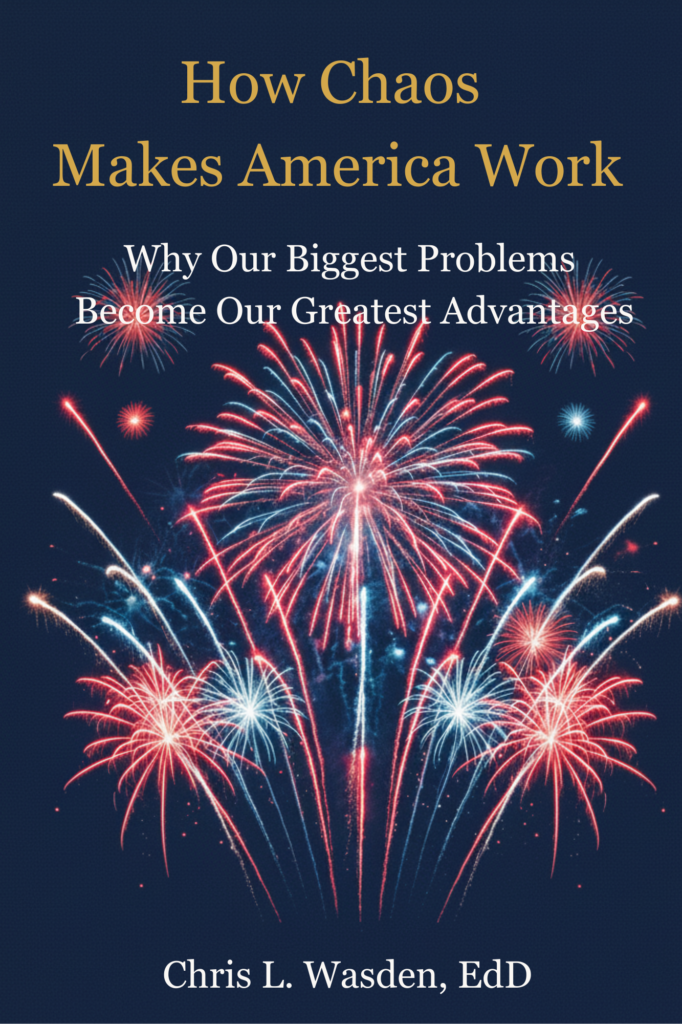
Why Our Biggest Problems Are Becoming Our Greatest Advantages.
How Chaos Makes America Work: Why Our Biggest Problems Become Our Greatest Advantages
Tension: The Energy of Innovation
Research shows that 98% of us test as creative geniuses at age five—yet only 2% retain that capacity by adulthood. What happened? Organizations trained us to be mindless, following standardized processes that deliver efficiency but kill innovation. In Tension, Chris and Mitch Wasden reveal that the discomfort we try to avoid—tension—is actually the energy source that powers breakthrough innovation. At the heart of the book is the Three Tensions Framework: when systems face disruption, they respond maladaptively (resisting change in ways that make things worse), adaptively (making incremental improvements within existing structures), or creatively (transforming the paradigm entirely). Drawing on neuroscience, complexity theory, and hard-won lessons from nine startups, the Wasdens show how to recognize which response you’re defaulting to—and how to harness tension as fuel for creative breakthroughs rather than letting it drive you toward maladaptive decline. Whether you’re a Fortune 500 executive or an entrepreneur searching for your next pivot, this book provides the framework for transforming organizational pain into innovation.

Solving for Why: Change Your Identity, Change Your Future
In Solving for Why: Change Your Identity, Change Your Future, co-authors Mitch Wasden and Chris Wasden, both Ed.D.s, harness the insights of neuroscience and complexity theory to illuminate a transformative truth: our deepest sense of purpose—or “why”—isn’t just motivational fluff but the neural architecture that reshapes personal and organizational destinies. By decoding how shared meaning fosters resilient cultures, the book equips leaders and individuals with practical frameworks to evolve their identities, turning everyday workplaces into engines of innovation and fulfillment that outstrip rote productivity metrics. Drawing on real-world case studies, from high-stakes corporate turnarounds to individual reinventions, the Wasdens argue that in an era of relentless disruption, embracing this “why”-driven evolution isn’t optional—it’s the secret to sustainable excellence, empowering us to not merely adapt to change but to author futures brimming with authentic impact and unyielding performance.

Chris Wasden
Author, Speaker, and Innovation Executive
“Helping pragmatic Americans understand why our country’s challenges are converting into advantages.”
Navigate
Connect
Stay Updated
Get weekly insights delivered to your inbox.Subscribe
© 2025 Chris Wasden. All rights reserved. Data Over Dogma. Frameworks Over Talking Points. Results Over Grievances.